Reconstruct the field
Bayesian Gaussian processes pool sparse survey evidence across space and time to infer smooth variant frequencies.
LANGUAGE · SPACE · TIME
The words we use tell a story of where we come from. Statistical physics helps us understand how that story changes.
Explore half a century of American English, from the geography of soda and pop to the forces that shape dialect boundaries.
A DIFFERENT WAY TO LOOK AT LANGUAGE
Why do some people say sneakers while others say tennis shoes? And why do these differences persist as people move and communities mix?
Two complementary studies by James Burridge, with Bert Vaux on the map-based study, connect survey evidence with statistical physics. A state field describes the relative frequency of each word across a landscape. Following that field through time reveals how local interactions and migration can reshape language.
TWO WAYS TO EXPLORE
Start with the evidence, then ask what could explain it.
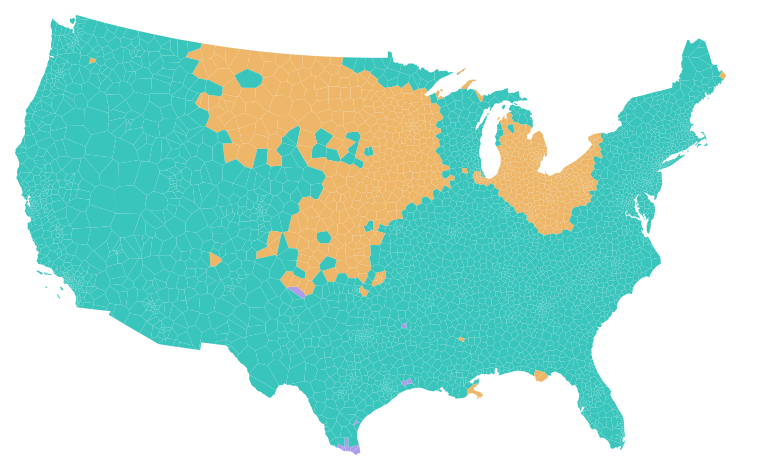
Move through reconstructed frequency maps from the Cambridge Online Survey of World Englishes. Discover how six everyday expressions vary across space and birth cohorts.
Explore empirical fields →Change migration, local copying, accommodation and bias. Watch how these mechanisms interact in a deterministic simulation of linguistic change.
Open the model sandbox →THE SCIENCE BEHIND THE MAPS
Migration mixes communities. Accommodation—the tendency to favour locally common variants—can counter that mixing and sustain distinct dialect regions. Combined with local diffusion, it can produce moving boundaries analogous to those studied in physical systems.
Read the map-based study ↗Bayesian Gaussian processes pool sparse survey evidence across space and time to infer smooth variant frequencies.
Replicator dynamics combine accommodation and bias with local copying and a migration model calibrated to IRS county-to-county data.
The research infers parameters by matching field dynamics and evaluates forecasts against held-out periods, up to 25 years ahead.
RESEARCH FOUNDATION
Statistical physics of language change inferred from time evolving maps (2026) ↗
James Burridge and Bert Vaux
Statistical field theory for dialectology (2025) ↗
James Burridge
These maps reconstruct birth-cohort differences using the apparent-time assumption. They are smoothed estimates among the included variants, not historical censuses or direct observations of each calendar year.